I first saw a drawing by Lebbius Woods while I was working
on my thesis project at the School of Architecture, University of Minnesota in
1974. It was (in my dusty memory) a simple
perspective drawing of an interior, but it was startling in several ways;
first, it was a perspective (unusual in those isometric days), second, it used
bright harmonious colors (in a time of white and wood), and finally, it was
fantastic rather than functional. It was
a unique vision in my constricted world, and it influenced my thesis project
immediately.
When I worked as an architect in NYC, Lebbius did renderings
on a number of projects I worked on. I
tried (and failed) to copy his style, which was always inimitable, but the
sheer challenge exhilarating. Later I
found that Lebbius’s rendering work was nothing more than the cash cow which he
used to fund his architectural explorations.
And his explorations would be the basis for his fame.
Unfortunately, Lebbius Woods died October 30. Although I had a couple of conversations with
him over the years, I can’t say that we were friends. Yet, he was one of the frames which directed
the path of my life, and I mourn the loss of one of the few geniuses I
knew. So, Lebbius is gone, but, as I
quipped to a friend, “he left his drawings.”
Above is Lebbius’s take on the Times Square Tower
Competition.
You can compare it to
my submission at the end of the last blog post on “conceptual sketches”.
I like to think that we were heading in the
same direction, but in any case it is interesting to compare and contrast.
Although He was already making a name in the early ‘70’s, I
have no drawings earlier than the 3 following from 1979. They show his love for developing patterns
and textures on flat surfaces, as well as an architectonic “homage” to van
Doesburg, Rudolph and Eisenman.
In 1982 he published AEON
the Architecture of Time. The rendering
technique is the same as his commercial rendering (color pencil), but the
effect is brooding and mysterious. He was
still working on ideas that hearken back to familiar forms such as 1930’s
skyscrapers, and his view through the branches looking toward a set of industrial
silos is almost picturesque. And yet,
the mood is dark in both cases.
Lebbius was drifting toward conceptual illustration, as
exemplified by this Sci-Fi book cover from 1983. Eventually he did work in Hollywood, which
was natural given his brilliant imagination.
Not long after, he was pushing his imagination into more
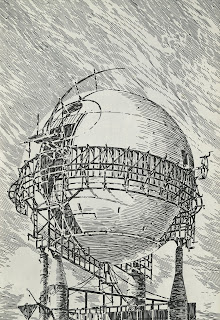
alien territory. Origins, from 1985 fused a rough ink technique with architectural
forms which are hard to categorize. But
the genius of his hand makes even the most curious features seem solid and
real. The closest “sources” I can think
of for these forms are the concrete masses of Louis Kahn, and the industrial
photographs of Bernd and Hilla Becher.
The following image, also from Origins, shows Lebbius starting to merge conceptual diagrams and
abstract doodles with his realistic renderings.
It is a montage board presentation technique that I love, but with an
extra creative twist or three. The
combination of abstract snapshots, obfuscating notation, and solid reality
creates a tension that he would exploit more and more in his exploratory career.
The rendering work is so solidly realistic that it is useful
to have examples of preliminary sketches.
The following two images are rough underlays of final drawings, and show
his ability to think in perspective terms while working out details.
Below is an example from The
New City which highlights the contrast of strange architecture and
beautifully believable rendering. The
nearly monochromatic color scheme is typical of his way of enforcing unity on
the unfamiliar.
This image from Anarchitecture
– Architecture as a Political Act, shows Lebbius’s sure eye for a simple
palette that harmonizes while challenging the conventional.
Another image from Anarchitecture
shows a fascination with destruction and decay; handled, as always, in the
most elegant way.
A final image from Anarchitecture,
below, is a tour-de-force of controlled chaos. The date is 1992, and the mood is a precursor
to many computer games which came out in the ‘90s. Again, the juxtaposition of near chaotic
abstraction, and strange realism is pure Lebbius.
By the mid ‘90s Lebbius was engrossed in the forms of
disaster and destruction, whether natural or manmade. His book Radical
Reconstruction (1997) moved solidly into the political; at least as far as
fantastic architecture can go along with politics. Below are designs based on structural failure
during earthquakes and floods, respectively.
He also riffed on the war time destruction of Sarajevo, and the economic
decay of Havana. The human figures on
the second image are a rare occurrence.
As with all our great historic artists, Lebbius Woods is
dead, but is not gone. His ideas and
drawings survive to inspire, instruct and challenge.